
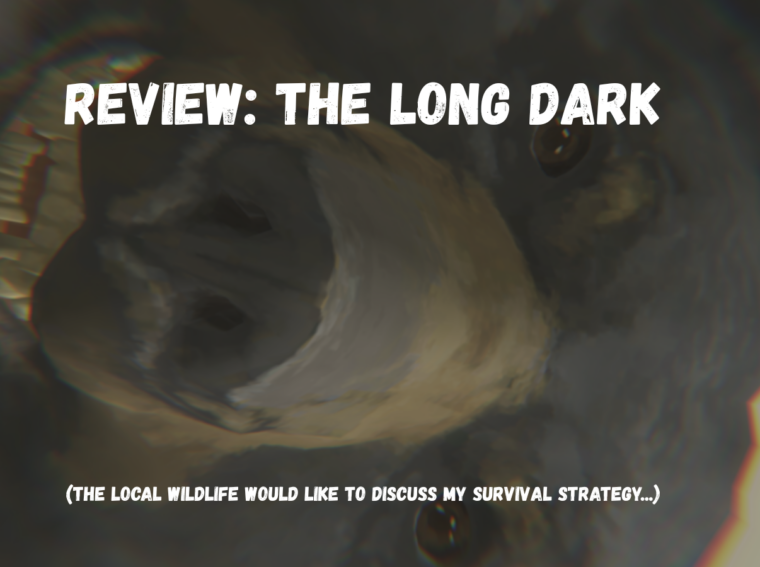
The Long Dark Review: Beautiful, Brutal and Quietly Addictive
The Long Dark, developed by Hinterland Studio, is one of my most-played games.
Why has it taken me this long to write a review? Quite simply, the game was not finished. I have been waiting years for the final chapter of its story mode to be released, and then waiting until I had enough time to give the game the review it deserves.
As the story is genuinely rather good, I will avoid spoilers and leave you to experience its mysteries and suspense for yourself.
At its heart, The Long Dark is a beautiful, quiet survival game set across the frozen landscapes of Great Bear Island in northern Canada. This is not a game about constructing an enormous fortress, mowing down hordes of enemies or becoming an unstoppable wilderness superhero. It is about finding shelter before nightfall, keeping a fire alive through a blizzard and wondering whether you can afford to use your final match.
Sometimes your greatest achievement is simply making it home with enough firewood to survive the night.
The game is divided into two main experiences: the narrative-driven story mode, WINTERMUTE, and the open-ended survival mode.
The Long Dark: Story Mode
Without giving too much away, WINTERMUTE follows bush pilot Will Mackenzie and Dr Astrid Greenwood after a mysterious disaster leaves them stranded in the snow-covered Canadian wilderness.
The two are separated and must survive while trying to find one another, gradually uncovering what has happened to Great Bear Island along the way.
Across its five episodes, you face hostile people, brutal weather, dwindling resources and hungry wildlife. You also meet survivors who need your help, some of whom may offer assistance or information in return.
The story mode gives the game more direction than survival mode, with objectives, characters and scripted events pushing you onwards. It also works as a useful introduction to many of the game’s central mechanics, including navigation, crafting, hunting, managing injuries and keeping yourself warm.
For new players, I recommend starting with the story. It gives you some idea of what the game expects from you and introduces several important locations and survival skills before you are thrown into the much less forgiving sandbox.
That said, the story does not hold your hand indefinitely. You will still get lost, freeze, become exhausted and make decisions that seemed perfectly sensible ten minutes earlier.
The Long Dark: Survival Mode
Survival mode is where I have spent most of my time, particularly while waiting through the years between each story episode.
It is also where The Long Dark truly shines.
There is no grand quest and no final boss. Your story emerges naturally from the decisions you make. You choose where to travel, which buildings to use as shelter, what supplies to carry and how much danger you are willing to accept.
One player might settle beside a frozen lake and live by fishing. Another might roam continuously between regions, hunting and scavenging as they go. You can live in a farmhouse, hide inside a lonely cabin or decide that climbing a mountain during a blizzard sounds like an entirely reasonable idea.
The game offers several preset difficulty levels, along with a detailed custom mode that lets you adjust many aspects of the experience.
Personally, I find Stalker to be the best balance. Resources are limited enough that survival still requires planning, while hostile wildlife keeps you under pressure whenever you leave shelter.
Pilgrim, the easiest setting, is excellent for players who want a cosier and more exploratory experience. Resources are more plentiful, wildlife is far less aggressive and you have more freedom to appreciate the landscape without every journey turning into a fight for your life.
At the other end, Interloper strips away much of the safety net. Essential equipment becomes scarce, the weather is harsher and even small mistakes can end a run that has lasted for weeks or months.
The custom settings are particularly welcome because they allow you to create the version of the game you actually enjoy. You can make the weather vicious without filling the map with aggressive wolves, increase the availability of supplies or create an almost peaceful wilderness experience focused on exploration.
Survival Is More Than a Hunger Bar
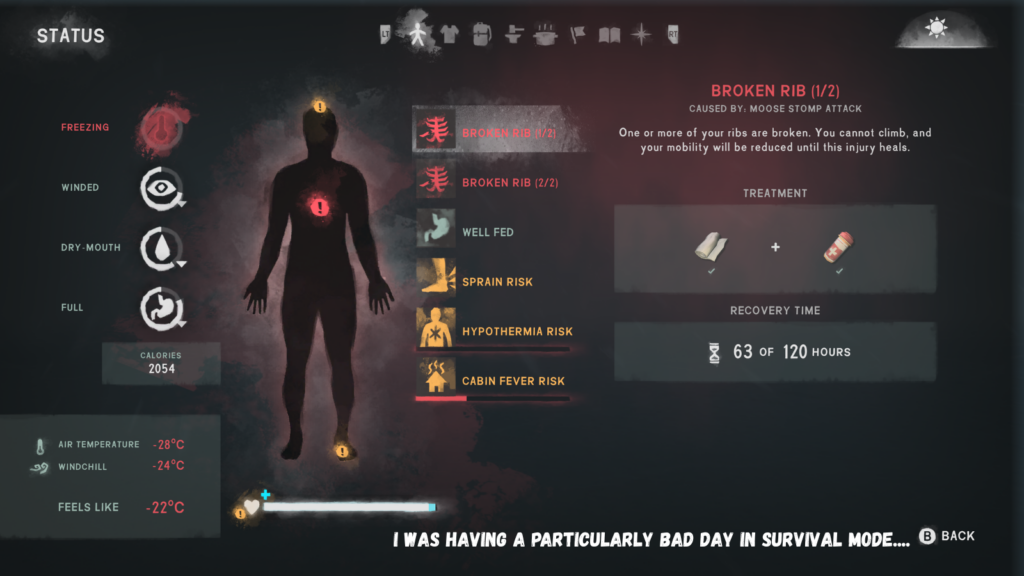
Your character must manage warmth, tiredness, hunger and thirst, but these basic statistics are only the beginning.
Clothing becomes wet, frozen or damaged. Food decays. Tools wear out. Injuries must be treated correctly, and untreated infections or parasites can become serious problems. Carrying too much leaves you exhausted, but leaving useful equipment behind may come back to haunt you.
Every journey becomes a calculation.
Do you carry additional food or save the weight for firewood? Do you use your remaining ammunition to hunt, or keep it in case a wolf finds you first? Do you push onwards through worsening weather, or retreat and risk running out of supplies?
The game is particularly good at making ordinary objects feel valuable. Finding a box of matches, a sewing kit or a tin opener can feel more exciting than discovering a legendary weapon in another game.
Your victories are small but meaningful because the game makes you earn them.
The World and Atmosphere
Visually, The Long Dark does not chase photorealism. Its landscapes have a painterly style, filled with strong silhouettes, muted colours and enormous skies.
The result is beautiful without making the wilderness feel welcoming.
The world can appear peaceful one moment and lethal the next. A clear morning can become a blizzard before you reach your destination. Familiar landmarks disappear behind snow, and a short walk between buildings can become a desperate attempt to avoid hypothermia.
Sound plays an equally important role.
Much of the game is quiet. You hear the wind against the walls, the creaking of trees, footsteps in the snow and the unsettling howl of a wolf somewhere beyond your firelight.
There is no constant noise demanding your attention. The silence gives the landscape weight, and it makes every unfamiliar sound matter.
The Wildlife
Wildlife is both a source of food and one of your greatest dangers.
Deer and rabbits may keep you alive, while wolves, bears and other predators can turn a routine supply trip into a disaster. Hunting requires patience, equipment and the ability to deal with the carcass before the weather changes or another animal takes an interest.
The wildlife behaviour is not always realistic, particularly on harder settings where wolves can feel less like animals and more like furry guided missiles. This is one area where the game occasionally sacrifices believable behaviour for mechanical pressure.
However, the threat they provide does stop the world from becoming completely comfortable. Even after hundreds of hours, hearing a wolf bark nearby still produces the immediate reaction of: “Oh, for God’s sake, where is it?”
A Slow Game, and Proud of It
The Long Dark will not suit everyone.
It is deliberately slow. You walk long distances, organise supplies, repair clothing, prepare food and wait for storms to pass. A badly planned journey can cost an hour of progress, and permanent death in survival mode means exactly that.
There are also moments when the game becomes repetitive. Experienced players may find themselves following familiar routines, and long-established survival runs can eventually lose some of their urgency once you have gathered enough equipment.
Yet that slowness is also the point.
The game gives you room to think. It allows tension to build naturally rather than constantly throwing enemies or scripted action at you. The danger comes from knowing that a series of small mistakes, rather than one dramatic battle, may eventually kill you.
Final Thoughts
After years of playing, The Long Dark remains one of my favourite survival games because it understands that survival does not need to be loud.
Its most memorable moments are rarely the ones the developers have scripted. They are the personal stories created by the systems: getting lost in a blizzard, stumbling across an abandoned cabin with seconds to spare or surviving a wolf attack only to realise that your bandages are back at home.
It can be peaceful, bleak, frustrating and beautiful, sometimes within the same ten minutes.
The story mode offers a compelling journey through the world of Great Bear Island, but survival mode is where the game earns its longevity. It gives you a landscape, a collection of survival tools and one simple challenge:
Stay alive for as long as you can.
For players who enjoy atmospheric exploration, methodical survival and games that allow silence to be part of the experience, The Long Dark is easy to recommend.
Just remember to take more matches than you think you will need.
Bearded Bear Gaming rating: 9 frozen tins of Pinnacle Peaches out of 10. IYKYK